Tennis Elbow: Why You’re in the Club
(And How to Resign Your Membership)
If you have ever felt a sharp, searing pain on the outside of your elbow when picking up a kettle, turning a screwdriver, or—heaven forbid—hitting a backhand, you’ve likely been initiated into a very common, yet frustrating group: the "Tennis Elbow Club."
Despite its name, Lateral Epicondylalgia (the clinical term for Tennis Elbow) is rarely about tennis. In fact, only about 5% of people diagnosed with the condition actually play the sport. At Beechboro Physiotherapy, we see this condition across a vast demographic, from tradespeople and office workers to weekend warriors and gardening enthusiasts.
The good news? While it can be persistent, it is highly treatable with an evidence-based approach to load management and strengthening.
What Exactly is Tennis Elbow?
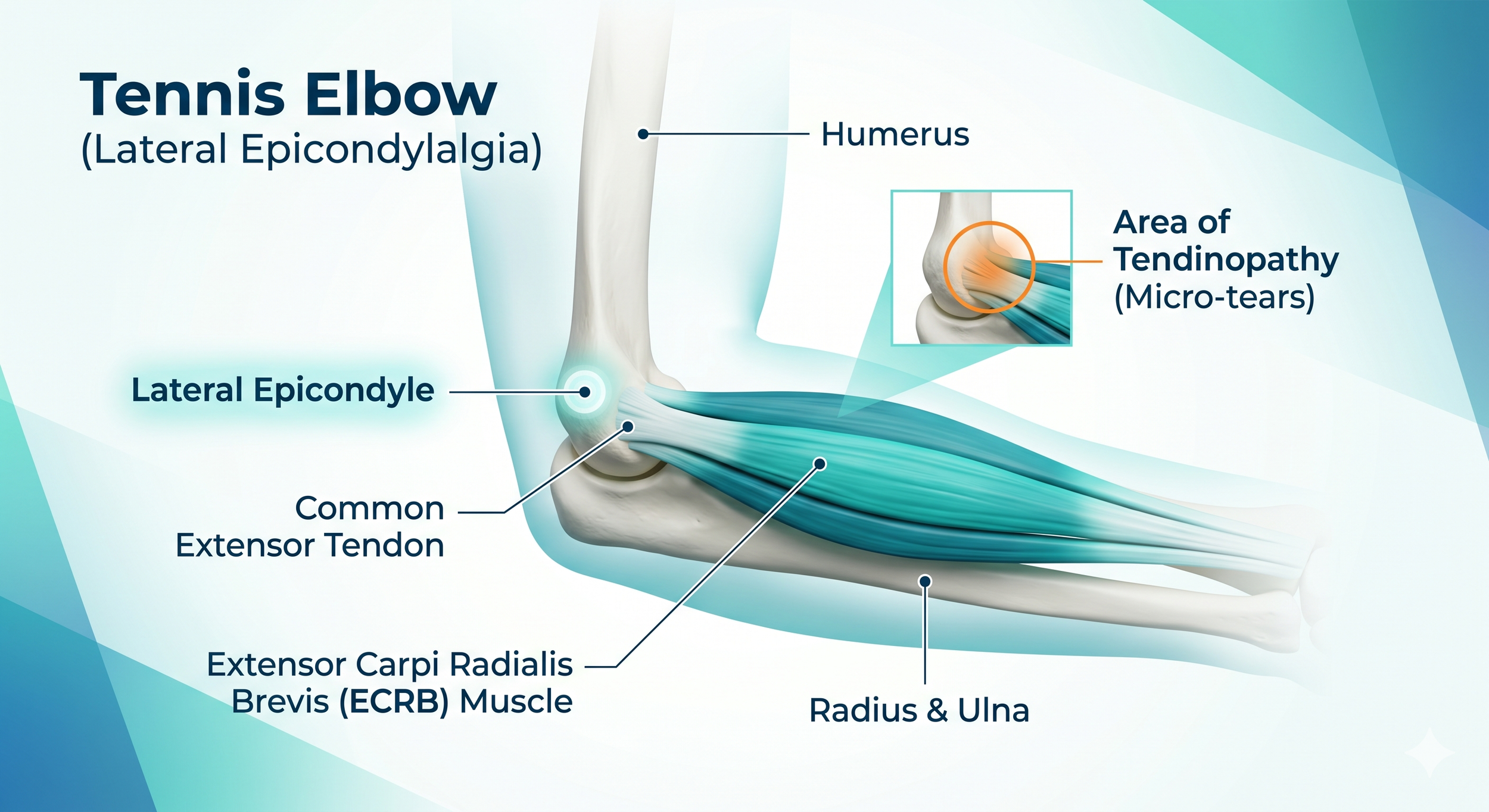
To understand how to fix it, we have to understand what it is. Tennis elbow is a tendinopathy affecting the common extensor tendon—the point where the muscles of your forearm attach to the bony bump on the outside of your elbow (the lateral epicondyle).
Specifically, the muscle most often involved is the Extensor Carpi Radialis Brevis (ECRB). This muscle helps stabilize the wrist when the elbow is straight. When we overwork this area through repetitive gripping or wrist extension, micro-tears can occur.
The Shift from "Itis" to "Osis"
In the past, people called it "Epicondylitis," implying inflammation. However, modern research shows that chronic tennis elbow is rarely inflammatory. Instead, it is a failure of the tendon to heal correctly under stress, leading to a breakdown in collagen tissue. This is why "ice and rest" alone rarely solves the problem long-term; we need to change how the tendon handles load.
By the Numbers: Who is Affected?
Tennis elbow doesn’t discriminate, but certain groups are more prone to the condition than others. Statistics show:
General Prevalence: It affects approximately 1% to 3% of the general population annually.
Age Brackets: The peak incidence occurs in adults aged 35 to 50. This is often when our activity levels remain high, but our tendons begin to lose some of their natural elasticity.
Gender: Men and women are affected equally.
Occupational Risk: People in manual labor roles (mechanics, carpenters, chefs) have a significantly higher risk due to repetitive forceful gripping. Studies indicate that in high-demand industrial jobs, the prevalence can jump as high as 15%.

Recognizing the Symptoms
How do you know if you’ve joined the club? Common signs include:
Lateral Pain: Tenderness directly on or just below the bony bump on the outside of your elbow.
Weak Grip: Finding it difficult to open jars, turn door handles, or hold a heavy frying pan.
Morning Stiffness: The elbow may feel "locked" or achy first thing in the morning.
Referred Pain: The discomfort may radiate down your forearm toward the wrist.
Why Me? Common Causes
Living in a vibrant community like Perth, our lifestyles often involve a mix of high-intensity work and active recreation. The primary driver of tennis elbow is unaccustomed load.
The Weekend Warrior: Spending six hours pruning the garden after three months of inactivity.
The Ergonomic Trap: Long hours at a computer with a poorly positioned mouse can lead to constant, low-grade tension in the forearm extensors.
The "Heavy Hitter": Increasing weights at the gym too quickly without allowing tendons to adapt.
The Path to Recovery: Evidence-Based Treatment
At Beechboro Physiotherapy, we move away from the "wait and see" approach. Research suggests that active rehabilitation is far superior to corticosteroid injections for long-term recovery. In fact, while injections may provide short-term relief (up to 6 weeks), long-term studies show they can actually lead to higher recurrence rates compared to physiotherapy.
1. Pain Management & Education
Initially, we focus on "settling the beast." This involves identifying the activities that aggravate your elbow and finding "work-arounds" to allow the tissue to calm down without stopping movement entirely.
2. Progressive Loading (The Gold Standard)
Tendons crave load—but it must be the right amount. We use a graduated exercise program that starts with isometric holds (holding a weight still) to reduce pain, moving into eccentric loading (lengthening the muscle under tension) to rebuild tendon strength.
3. Kinetic Chain Assessment
Sometimes, the elbow is the victim of a crime committed elsewhere. If your shoulder is weak or your mid-back (thoracic spine) is stiff, your elbow may be overcompensating. We look at the whole body to ensure the problem doesn't return.
Top 3 Exercises for Tennis Elbow
Note: These should be performed within a "comfortable" pain range (0-3 out of 10).
1. Wrist Extension Isometrics
How: Sit with your forearm resting on a table, palm facing down, hand hanging over the edge. Use your other hand to lift your wrist up, then hold it there against gravity or with a very light weight.
Why: Holding still (isometrics) creates an analgesic effect, reducing pain while starting to load the tendon.
Repetition: Hold for 30–45 seconds, repeat 3 times.
2. Eccentric Wrist Extensions
How: Using a light weight (or a water bottle), lift your wrist up using your "good" hand. Then, slowly lower the weight using only your affected hand, taking 3–5 seconds to reach the bottom.
Why: Eccentric lowering helps stimulate collagen production and realigns the fibers in the tendon.
Repetition: 3 sets of 10–12 reps.
3. Forearm Supination/Pronation
How: Hold a hammer or a light dumbbell by the bottom of the handle. Slowly rotate your palm to face the ceiling, then slowly rotate it to face the floor.
Why: This strengthens the rotational muscles of the forearm which support the elbow joint.
Repetition: 2 sets of 15 reps.

When to Seek Help?
If your elbow pain is preventing you from sleeping, limiting your ability to work, or hasn't improved with two weeks of rest, it’s time for a professional assessment. Chronic tendon issues become harder to treat the longer they are left, as the tissue becomes more disorganized.
At Beechboro Physiotherapy, we don't just give you a generic sheet of exercises. We tailor a plan to your specific goals—whether that’s getting back on the court, back on the tools, or simply being able to lift your grandkids without pain.
If you need support, call Beechboro Physiotherapy on 9377 2522 to book an appointment.